
There was a time—not so long ago—when flour wasn’t a commodity. It was alive with variation, shaped by soil, weather, and the hands that grew and milled it. Wheat wasn’t always white. Bread wasn’t always light. And nourishment wasn’t something we had to chase—it was built in.
Somewhere along the way, we simplified too much.
The Maslin Method
Maslin is a historical term that originated around the 13th century from Old French mesteillon, derived from Latin mixtus or a mixture of different grains (typically wheat and rye) that were grown and milled together to make flour or bread. Historically, it was a peasant staple used as insurance against crop failure, ensuring some yield even if one grain failed. In our monocropping world, diversity is gaining traction, albeit too slowly, as vitally important.
Originally, it wasn’t trendy—it was practical:
• Crop security: If one grain failed, the other might survive
• Cost-effective: Rye was often cheaper and hardier
• Nutrition: More diverse nutrients than a single grain
• Flavor & texture: More complex than plain wheat
The Maslin method is simply the art of blending flour to create a more balanced, flavorful, and nourishing bread. Before modern agriculture gave us uniform white flour, bakers worked with what the land provided. One result of that tradition is maslin—a simple blend of grains, most often wheat and rye, grown and milled together. The bread that came from it was nourishing, resilient, and deeply flavorful.
Today, the Maslin approach offers something quietly powerful: instead of relying on a single flour, we blend flours intentionally to create better structure, flavor, and nutrition.
The typical approach is to combine a strong flour (like wheat) with a more flavorful or nutrient-dense flour (like rye, spelt, or others).
There’s no single rule, but common blends include:
• 70–80% wheat + 20–30% rye → good structure, mild flavor
• 60% wheat + 40% rye → denser, more rustic
• 50/50 → very traditional, hearty, less rise
Each grain brings something different:
• Wheat → structure, rise (gluten)
• Rye → moisture, depth, earthiness
• Spelt → digestibility, mild sweetness
• Whole grain flours → fiber, nutrients, complexity
Simple Maslin-style flour blends
Beginner (light + balanced):
• 75% bread flour
• 25% whole rye or whole wheat
Rustic (more flavor, still good rise):
• 60% bread flour
• 40% mix of rye + spelt
Hearty (denser, traditional feel):
• 50% bread flour
• 50% rye or whole grain mix
Gentle and digestible:
• 70% bread flour
• 20% spelt
• 10% rye
Ancient and Heritage Grains
Many people find they tolerate traditional grains better than modern, highly hybridized wheat.
Some to explore:
• Spelt – slightly sweet, more soluble gluten
• Einkorn – one of the oldest wheats, delicate and nutrient-dense
• Emmer – rich, nutty flavor*
• Rye – grounding, mineral-rich
*If you want to read more about Emmer and Farro, click here. As an aside, I love Bob’s Red Mill products and use them frequently, but this is good information from Bluebird Grain Farms.
These grains connect us to agricultural traditions that valued resilience over uniformity.
Sourdough: A Living Process
Through natural fermentation:
• Gluten is partially broken down
• Nutrients become more bioavailable
• The bread becomes easier to digest
It also slows us down—something most of us need.
Sourdough Maslin Bread
I strongly suggest using a kitchen scale and grams.
Ingredients:
• 400g bread flour
• 100g rye flour
• 350g warm water
• 100g sourdough starter (fed or unfed/discard*)
• 12g sea salt
Directions:
Whisk the starter and water together in a large bowl with a Danish dough whisk or a fork. Add the flour and salt. Mix to combine, finishing by hand to form a rough dough. Cover with a damp towel and let rest for 30 minutes.
After 30 minutes, grab a corner of the dough and pull it up and into the center. This is called stretch and fold. Let the dough rest for another 30 minutes, then repeat the stretching and folding. If possible, do this twice more for a total of 4 times in 2 hours. If not, that’s ok, it will still work.
Cover the bowl with parchment paper and a damp cloth. I try not to use plastic, but if you do, that works too. Let the dough rise at room temperature, about 8 to 10 hours at 70°F, until it has increased by 50-75% in volume.
Place the dough onto a lightly floured surface and gently shape it into a round. Place the dough into a proofing basket dusted with flour. Cover the dough and refrigerate overnight or up to 3 days.
Place a Dutch oven in the oven and preheat to 550°F. Cut a piece of parchment to fit the size of your Dutch Oven.
Place the parchment over the dough and invert the bowl to release. Using the tip of a small knife or a razor blade, score the dough as simply or fancifully as you like. Use the parchment to transfer the dough into the preheated Dutch oven carefully.
Cover the pot. Lower the oven to 450F and bake for 30 minutes, covered. Remove the lid, lower the temperature to 400ºF, and continue to bake for 15 -20 minutes more. Ideally, cool on a wire rack for 1 hour before slicing. (Good luck with that…)
*Yes—you can use unfed starter (discard). It will add flavor and be slightly less active → longer rise time may be needed.
Side note: For this bread, I used 300 grams of bread flour, 150 grams of Einkorn flour, and 50 grams of rye flour.
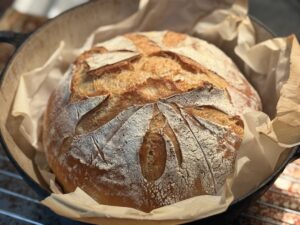
You can see in the above photo how the Dutch Oven (pan) is lined with parchment paper)
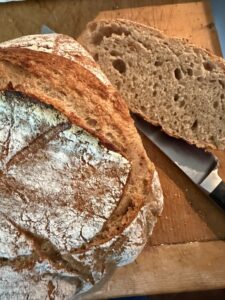
Maslin Bread with Yeast (No Sourdough)
Ingredients:
• 400g bread flour
• 100g rye flour
• 350g warm water
• 7g active dry yeast (1 packet)
• 12g sea salt
Directions:
1. Dissolve yeast in warm water. Let it rest for 5–10 minutes.
2. Mix in the flours and salt.
3. Knead (or stretch and fold) until smooth.
4. Let rise 1–2 hours, until doubled.
5. Shape and rest 30–60 minutes.
6. Bake at 425°F for 40 minutes.
Side note: For this bread, I used 300 grams of bread flour, 100 grams of whole-wheat flour, and 100 grams of rye flour. Also, bake in an 8” loaf pan. A 9” will work, but the 8” makes a taller loaf.
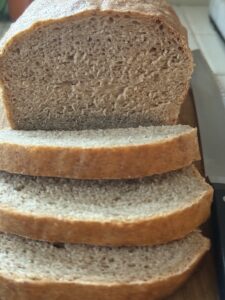
The Maslin method isn’t complicated—it’s intuitive. This may take a few tries to get the feel of the process and the dough.
There is something deeply grounding about working with whole grains, blending flours, and allowing time—whether through fermentation or simple intention—to be part of the process.
Flour is not just an ingredient, it’s a connection—to land, to tradition, to nourishment. Enjoy!