The accident taught me that health is not the absence of symptoms. It’s the ability to continue living fully while caring for the body that carries you there.
Most of us have a “before” and “after” story somewhere in our lives. We probably all have more than one. I know I do, but this one has been the most challenging.
About a year and a half ago, I was minding my business driving through a green light when bam! a red car was in my car. The driver had run the red light and smashed into me. The man behind me had a dash cam, so there was no question that she was at fault. Until that day, I was never sore—no aches and pains at all. That changed that day.
Before the accident
• no pain
• body felt predictable
• movement was effortless
After the accident
• soreness here and there
• greater awareness of my body
• searching for ways to restore function, constantly
• learning what helps and what doesn’t
Some of you might see:
• surgery
• aging
• sports injuries
• caregiving
• illness
The details differ, but the lesson is similar.
The body adapts, but not in the trauma-book sense. In the practical sense.
• The body compensates.
• The body protects.
• The body learns.
• Sometimes those adaptations help.
• Sometimes they create new challenges.
By the way, I don’t generally write with so many bullet points, but for this journey, they have helped me keep track of everything I have tried.
My story is about adaptation.
Right after the accident, my panicked daughters dashed to me. I guess I called them, but I don’t remember doing so. My son was on an airplane but kept in contact with his sisters. An MRI, CT scan, and a once-over by the doctor. No broken bones, but a nasty whiplash and muscles that were traumatized. Next came physical therapy. I had never been to a PT before, so I wanted to know everything he was doing and why. Big surprise. I need to know the details, so I understand. Next was acupuncture. The acupuncturist said she could feel the trauma in my muscles. I did stretching exercises at home. Ate an anti-inflammatory diet, which, quite frankly, I eat 90% of the time anyway.
Fast forward to today, and I am still sore, sometimes to the point that when I get out of the car after driving for a while, I have to stand there and stretch because my back and hips hurt so much.
Aches and pains are now part of my life, but I am still searching for new ways to help my body recover. I must say that I have never stopped exercising after the first few weeks of going really slow. I don’t feel like I felt before, but I don’t slow down. I live my life exactly how I did before, but with soreness.
Healing and Restoration Are Not the Same Thing
I discovered that recovery is less about returning to a previous version of myself and more about learning how to move comfortably in the body I have now.
Small Things Matter
A walk.
A stretch.
A mobility exercise.
A good night’s sleep.
These rarely feel dramatic.
Yet over months and years, they often matter more than grand gestures.
This brings us to something I started today. Dead hanging.
Anthropologists and movement researchers have pointed out that:
• children hang
• climb
• swing
• monkey-bar their way through life
Adults spend much of their time:
• sitting
• driving
• typing
• looking at screens
with very little time spent reaching overhead or bearing weight through our arms.
Some movement experts state that dead hangs restore a movement pattern that has largely disappeared from modern life.
Dead hangs may gently decompress the spine by utilizing gravity to create space between your vertebrae, briefly alleviate pressure, rehydrate your spinal discs, and relieve tightness in your back and shoulders. Many state that if you have shoulder injuries, this might not be for you.
I started today with a supported hang. Instead of completely suspending myself on the bar at the kid’s park down the street, I….
• grabbed the bar
• keep my toes lightly touching the ground
• gradually let some of my body weight hang
In a week or so, I will do a dead hang
• I will reach the bar without jumping.
• Keep my hands shoulder-width apart.
• Allow my body to hang completely straight.
• I will not let my lower back arch, and will gently engage my core, squeeze my glutes, and keep my chin tucked.
• I will hold for 10 to 30 seconds, perhaps working my way up to 60 seconds over time.
• I will then slowly step back onto the ground or floor (if you’re in a gym) before letting go of the bar to avoid sudden impact.
• If the hang causes any sharp pain or shooting sensations down your legs, I will stop.
I’ll let you know how it goes!
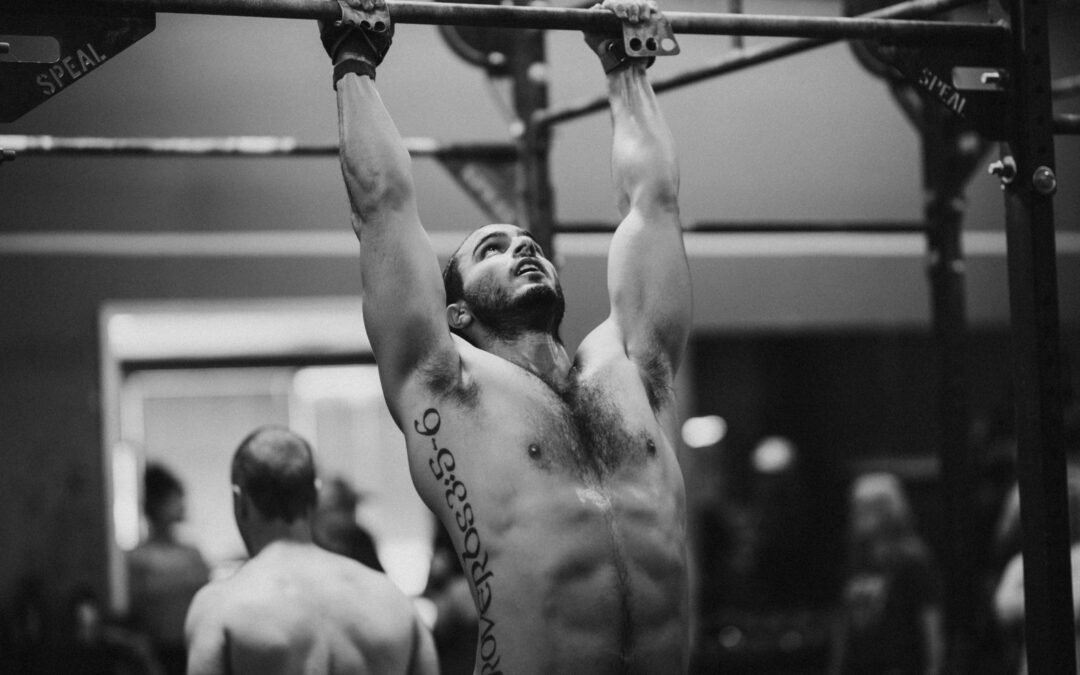
Do you notice that his arms are shoulder distance apart? That’s correct, based on what I have read. By what I read, you’re supposed to tuck in your chin, not look up.